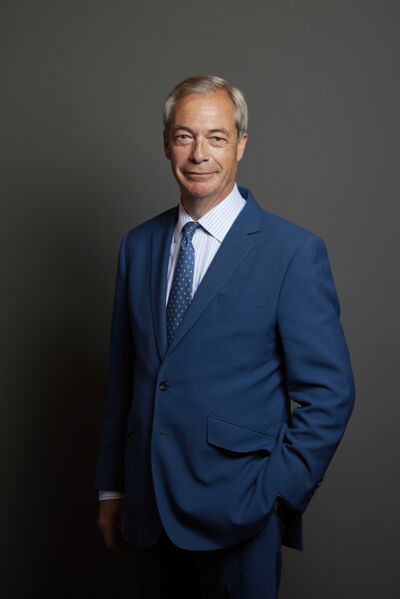
Nigel Paul Farage is the most consequential figure in British populist politics of the modern era. As the leader of UKIP, then the Brexit Party, and now Reform UK, he has been the dominant force on the British right outside the Conservative Party for more than two decades — and in 2016, led the campaign that delivered Brexit, one of the most significant shifts in post-war British history.
Early Life and Career Before Politics
Farage was born on 3 April 1964 in Farnborough, in what is now the London Borough of Bromley. He was educated at Dulwich College, the independent school in south-east London attended by other notable alumni including P. G. Wodehouse and Raymond Chandler. At school, he was already known for his debating abilities and provocative opinions — a schoolmaster's letter from the mid-1980s, later made public, expressed concerns about his associations with far-right views, though Farage has consistently denied holding such views.
Rather than attending university, Farage went directly into the City of London in 1982, working as a commodities trader at the London Metal Exchange. He spent 17 years in the City, primarily trading metals, and built a significant personal fortune. His years in the Square Mile gave him the financial independence to pursue politics without a salary and an instinctive distrust of regulation that would inform his political philosophy throughout his career.
The Rise Through UKIP
Farage became a founding member of the UK Independence Party in 1993, motivated by his opposition to the Maastricht Treaty and what he saw as the creeping federalism of the European project. He was elected as a Member of the European Parliament (MEP) for the South East England region in 1999 — a position he would hold until 2020.
In Brussels and Strasbourg, Farage became notorious for his confrontational speeches directly attacking EU leaders and commissioners. His address to Herman Van Rompuy, the then-President of the European Council, in which he asked who Van Rompuy was and declared he had "the charisma of a damp rag", received tens of millions of views online and made him an international figure. He led UKIP from 2006 to 2009 and again from 2010 to 2016, transforming a fringe Eurosceptic party into a major political force that at one point topped the polls for European Parliament elections.
Brexit and the 2016 Referendum
The 2016 EU membership referendum was the defining moment of Farage's political career. He led the Leave.EU campaign — distinct from the official Vote Leave campaign — and was the most prominent face of the Leave movement in public debate, on television, and at rallies across the country. When the result came in at 52% to 48% in favour of Leave, Farage declared it "a victory for real people, a victory for ordinary people, a victory for decent people."
His influence over David Cameron's decision to hold the referendum in the first place is widely acknowledged: it was UKIP's growing electoral threat — particularly after winning the 2014 European Parliament elections — that persuaded Cameron to promise a referendum in his 2015 manifesto.
Reform UK and the 2024 Election
After the Brexit Party delivered its purpose and the pandemic disrupted politics, Farage stepped back from leadership in 2021, handing the reins to Richard Tice. He returned to front-line politics in June 2024 — just weeks after Rishi Sunak called a snap general election — announcing that he would lead Reform UK and stand in Clacton, Essex.
His return transformed the election. Reform UK surged in the polls, ultimately securing 4.1 million votes (14.3% of the national share) — the third-highest vote total of any party. Farage himself won Clacton at his seventh attempt, finally breaking his Westminster losing streak after six previous failed bids, becoming an MP for the first time at the age of 60.
In Parliament
As leader of the Reform UK parliamentary group, Farage has used the Commons as a platform for his movement's issues: immigration, the cost of living, NHS waiting lists, and what he describes as the failure of the mainstream political class. He has clashed repeatedly with Labour ministers and has been a persistent critic of what he sees as politically correct policing and two-tier justice.
"A victory for real people, a victory for ordinary people, a victory for decent people."Nigel Farage, on the Brexit referendum result, June 2016
Key Policy Positions
- Immigration: Freeze non-essential immigration; process and deport illegal arrivals within weeks; leave the ECHR if it prevents deportations
- NHS: Cut waiting lists to zero within two years; hire 40,000 more clinical staff; cut 20% of NHS managers
- Tax: Raise income tax threshold to £20,000; no income tax on minimum wage; cut corporation tax for small businesses
- Energy: Scrap net zero; reopen North Sea licensing; cut energy bills by ending green levies
- Crime: Zero tolerance policing; end early release of violent offenders; restore stop and search
Career Timeline
- 1964Born 3 April in Farnborough, Kent (now London Borough of Bromley)
- 1982Joined London Metal Exchange as commodity broker after Dulwich College
- 1993Founding member of UKIP
- 1999Elected MEP for South East England
- 2006First term as UKIP leader
- 2010Returned as UKIP leader; survived small plane crash on election day
- 2014UKIP tops European Parliament elections — first non-Conservative or Labour party to win a national vote in over 100 years
- 2016Led Leave campaign; Brexit referendum won 52%–48%
- 2019Founded Brexit Party; won European Parliament elections with 31% of vote
- 2021Handed leadership of Reform UK to Richard Tice
- 2024Returned as Reform UK leader; elected MP for Clacton
Frequently Asked Questions
Nigel Farage (born 3 April 1964) is the leader of Reform UK and MP for Clacton in Essex. He is the most influential figure in British populist politics of the past 25 years, having led UKIP, the Brexit Party, and now Reform UK. He is widely credited as the driving force behind the 2016 Brexit referendum and its Leave victory.
Nigel Farage was born on 3 April 1964, making him 62 years old as of 2026. He grew up in Farnborough, in what is now the London Borough of Bromley, and attended Dulwich College in south-east London.
Nigel Farage is based in his Clacton constituency in Essex, where he was elected MP in July 2024. He previously lived in Kent and has maintained strong ties to south-east England throughout his political career.
Nigel Farage was educated at Dulwich College, an independent school in south-east London. He did not attend university, instead going into the City to work as a commodity broker at the London Metal Exchange after leaving school in 1982.
Before entering politics full-time, Farage worked for 17 years as a commodity broker in the City of London, specialising in metals trading at the London Metal Exchange. He became a millionaire during this period. He stood for Parliament while still working in the City, becoming an MEP in 1999.
Farage has consistently campaigned for sharp reductions in net migration to the UK. He argues that mass immigration has suppressed wages for working people, strained public services, and changed communities without democratic consent. Reform UK's 2024 contract pledged to freeze non-essential immigration, deport illegal arrivals within weeks, and cap legal migration.
Farage is a prominent critic of net zero policies. He believes the UK's current energy policy — including the ban on new petrol and diesel cars and reliance on offshore wind — damages the economy and raises household energy bills without meaningfully affecting global temperatures. Reform UK would scrap net zero targets and reopen North Sea oil and gas.
No. Nigel Farage has never been Prime Minister or held any ministerial position. Despite enormous influence — arguably more than any non-governing politician since Enoch Powell — he has operated entirely outside government, spending most of his career in the European Parliament rather than Westminster.
Farage stood for Westminster six times before finally winning Clacton in July 2024 — his seventh attempt. He stood in Eastbourne (1994), Salisbury (1997), Bexhill and Battle (2001), South Thanet (2005), Buckingham (2010), and South Thanet again (2015), losing each time before his 2024 victory.
Reform UK pledges to cut NHS waiting lists to zero within two years by hiring 40,000 more nurses and doctors, cutting NHS management by 20%, and stopping non-essential spending. Farage supports the principle of a free-at-the-point-of-use NHS but argues the current management culture is failing patients.
Independent Reform UK Coverage
News, analysis, polling, and constituency tracking from ReformHome.